
A kitten milk replacer is a powdered formula that stands in for the mother cat’s milk when she cannot feed her kittens: she is missing, unwell, has too little milk, or has more kittens than she can manage. Mixed with lukewarm water and given by kitten bottle or syringe, it is the only food a kitten needs for the first 3 to 4 weeks of life.
Kittens are far smaller than most puppies. A newborn weighs only 80 to 120 g, and a whole day’s feed in the first week is less than a small cup of tea. That is why the amount has to be worked out from the kitten’s weight, why feeds are tiny and frequent, and why a kitchen scale matters more than any other tool.
This guide covers how much to feed by weight and age, how often, how to mix and bottle-feed safely, how to tell your kitten is growing well, how long a pack lasts, and when to wean. The mixing ratio comes from the directions on Lact-O-Cent, our puppy and kitten weaning formula; the daily amounts follow veterinary guidance for orphaned kittens. For a newborn, a weak kitten, or one that is not gaining weight, always check with your vet.
Quick Answer: How Much Kitten Milk Replacer to Feed
A kitten needs about 18 ml of made-up formula per 100 g of body weight per day (VCA Animal Hospitals). Weigh the kitten, work out the day’s total, and split it across the feeds below. Our feeding calculator works this out for your kitten or litter.
| Kitten age | Typical weight | Formula per day | Feeds per day | Per feed (about) |
|---|---|---|---|---|
| Week 1 | 100-200 g | 18-36 ml | 7-8 (every 3 hours, day and night) | 3-5 ml |
| Week 2 | 200-300 g | 36-54 ml | 6 (every 4 hours) | 6-9 ml |
| Week 3 | 300-400 g | 54-72 ml | 5-6 | 10-13 ml |
| Week 4 | 400-500 g | 72-90 ml | 4-5, plus lapping practice | 15-20 ml |
Mix Lact-O-Cent at its label ratio: 1 g powder to 3 ml lukewarm water (10 g in 30 ml). For a 100 g kitten that is about 6 g of powder a day, made up to roughly 18 ml. The per-feed amounts printed on the pack are written for puppies, which are much bigger, so for kittens always go by weight. Start at the lower end and increase slowly if the kitten is hungry and its stools stay firm.
When Does a Kitten Need a Milk Replacer?
The mother’s milk is always first choice. Reach for a replacer when:
- You find orphaned or abandoned kittens. First check from a distance for an hour or two: the mother often comes back. If she does not, the kittens need warmth and formula.
- The mother has little or no milk, which can happen after a hard birth or illness.
- The litter is large and the smallest kittens are pushed off the teats and fall behind on weight.
- The mother is on medication your vet says should not pass into the milk.
- A kitten is weak or small and needs top-up feeds between nursing.
- Weaning starts at 3 to 4 weeks, when formula is mixed into the first soft food.
If a kitten cries constantly, feels cool to touch, or is not gaining weight while nursing, it may not be getting enough milk. Weigh the litter and speak to your vet before you start top-up feeds.
Why Kittens Should Never Get Cow’s Milk
Cow’s milk is the most common mistake, and kittens suffer more from it than puppies. A mother cat’s milk has more than twice the protein of cow’s milk; cow’s milk is also lower in calories, fat and taurine, and higher in lactose (VCA). The extra lactose often causes loose stool, which can dehydrate a 100 g kitten within hours.
Taurine deserves a special mention. Cats cannot make enough of it on their own, and it is needed for healthy eyes and heart. A formula meant for kittens must contain it. Lact-O-Cent does, along with lysine, methionine and arginine.
| Option | Fit for a kitten? | Why |
|---|---|---|
| Mother cat’s milk | Best | Made for kittens |
| Kitten milk replacer | Best substitute | Protein, fat and taurine matched to kittens |
| Puppy-only formula | Check the label | Some lack the taurine kittens need |
| Cow’s or buffalo milk | No | Too little protein and taurine, too much lactose |
| Homemade egg-and-milk mix | Emergency only, a few hours | Unbalanced and spoils fast |
What to Look For in a Kitten Milk Replacer
- Taurine on the label. Non-negotiable for cats.
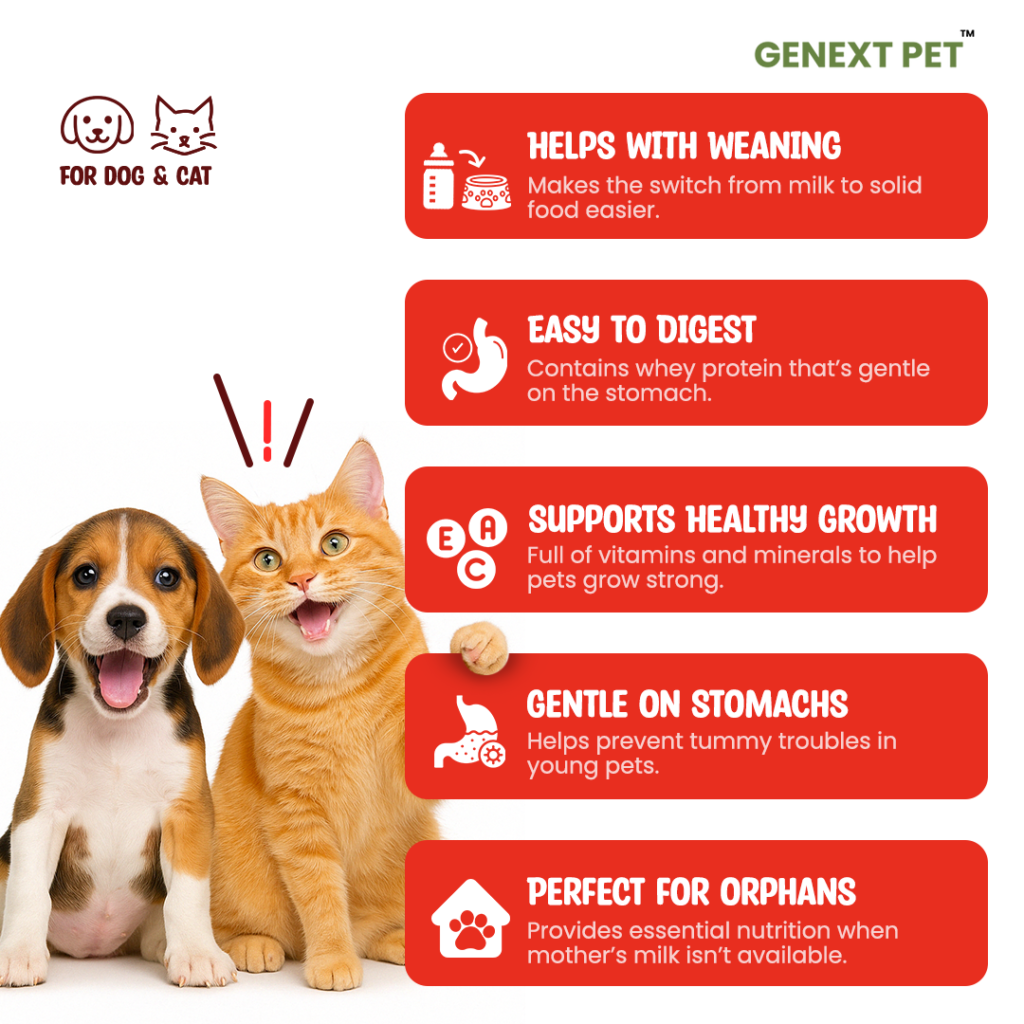
- High protein for fast growth. Lact-O-Cent has 21% protein.
- Low lactose, gentle on a tiny stomach. Lact-O-Cent has 5% lactose.
- Calcium, phosphorus and vitamins A, D, E, C and B-complex for bones, teeth and overall growth.
- Fats and essential fatty acids for energy and brain and eye development.
- Dissolves smoothly in lukewarm water, so nothing blocks a small kitten teat.
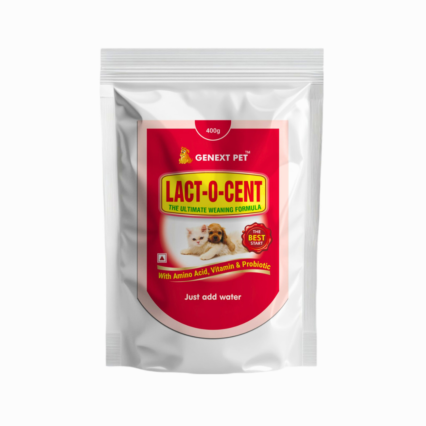
Lact-O-Cent also contains a probiotic (Saccharomyces boulardii) and nucleotides, which support the gut and early growth. The same pack works for puppies too, handy for rescuers and fosters who take in both.
-
Sale!
 This product has multiple variants. The options may be chosen on the product page
Lact-O-Cent® Puppy & Kitten Milk Replacer – Weaning & Growth Formula | 400g
Price range: ₹522 through ₹1,557
How to Prepare Kitten Formula
- Clean and sterilise. Wash your hands. Wash the bottle or syringe, teat and scoop, and boil them between uses.
- Weigh the powder. Small amounts are hard to judge by scoop, so a kitchen scale that reads single grams helps.
- Add lukewarm water at 1 g powder to 3 ml water. Aim for about 38°C: a few drops on your wrist should feel warm, not hot. Cold formula can cause vomiting, bloating and loose stool.
- Shake until completely smooth. Lumps block the teat.
- Make no more than one day’s supply, keep it in the fridge, and rewarm only what you need. Throw away anything left out for more than an hour.
Never microwave the formula. Stand the bottle or syringe in a cup of warm water instead.
How to Bottle-Feed a Kitten Safely
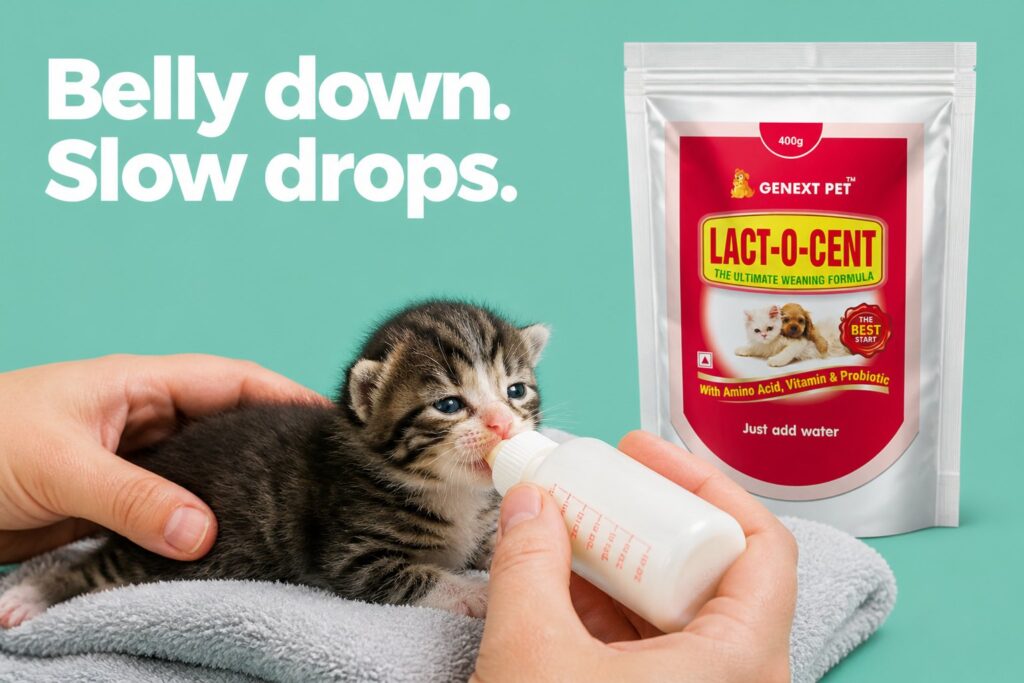
- Warm the kitten first. A cold kitten cannot digest. If it feels cool, warm it slowly on a covered heating pad or hot-water bottle before feeding, never feed it cold.
- Belly down, head level. Hold the kitten horizontal on a towel, the way it lies to nurse. Never feed it on its back like a human baby; milk can go into the lungs.
- One drop at a time. Turned upside down, the teat should drip slowly. A stream can choke a kitten and cause pneumonia.
- Let it suck; never squeeze. With a syringe, give a drop, wait for the swallow, then the next.
- Burp gently by patting the back after each feed.
- Help it pee and poop. Kittens cannot go on their own until about 3 weeks. After every feed, rub the area under the tail with warm, damp cotton until it goes (VCA).
- Clean its face so milk does not dry on the fur.
Very small or weak kittens that cannot suck need your vet’s help; some need tube feeding, which should only be done by someone trained.
Is Your Kitten Growing Well?
Weigh each kitten at the same time every day for the first 4 weeks, then weekly. A healthy kitten gains at least 7 g a day and about 100 g a week (VCA). Keep a small notebook: weight, feeds, pee and poop, so problems show early.
| Age | What you should see |
|---|---|
| Day 1-7 | Gains weight daily; sleeps most of the time; eyes closed |
| Day 7-14 | Eyes start to open; weight about double the birth weight |
| Week 3 | Starts to crawl and stand; can begin to pee on its own |
| Week 4 | Walks, plays, teeth coming in; ready to try lapping |
Call your vet the same day if a kitten:
- Loses weight, or gains nothing for a day
- Feels cold, will not suck, or cries non-stop
- Has milk from its nose, coughs or breathes noisily after feeds
- Has a swollen belly, vomits, or has watery stool
With kittens it is safer to slightly underfeed than overfeed. Overfeeding, cold formula and fast flow are the usual causes of bloating and loose stool. If stools turn loose, reduce the volume a little at the next feeds.
How Long Does a 400 g Pack Last for Kittens?
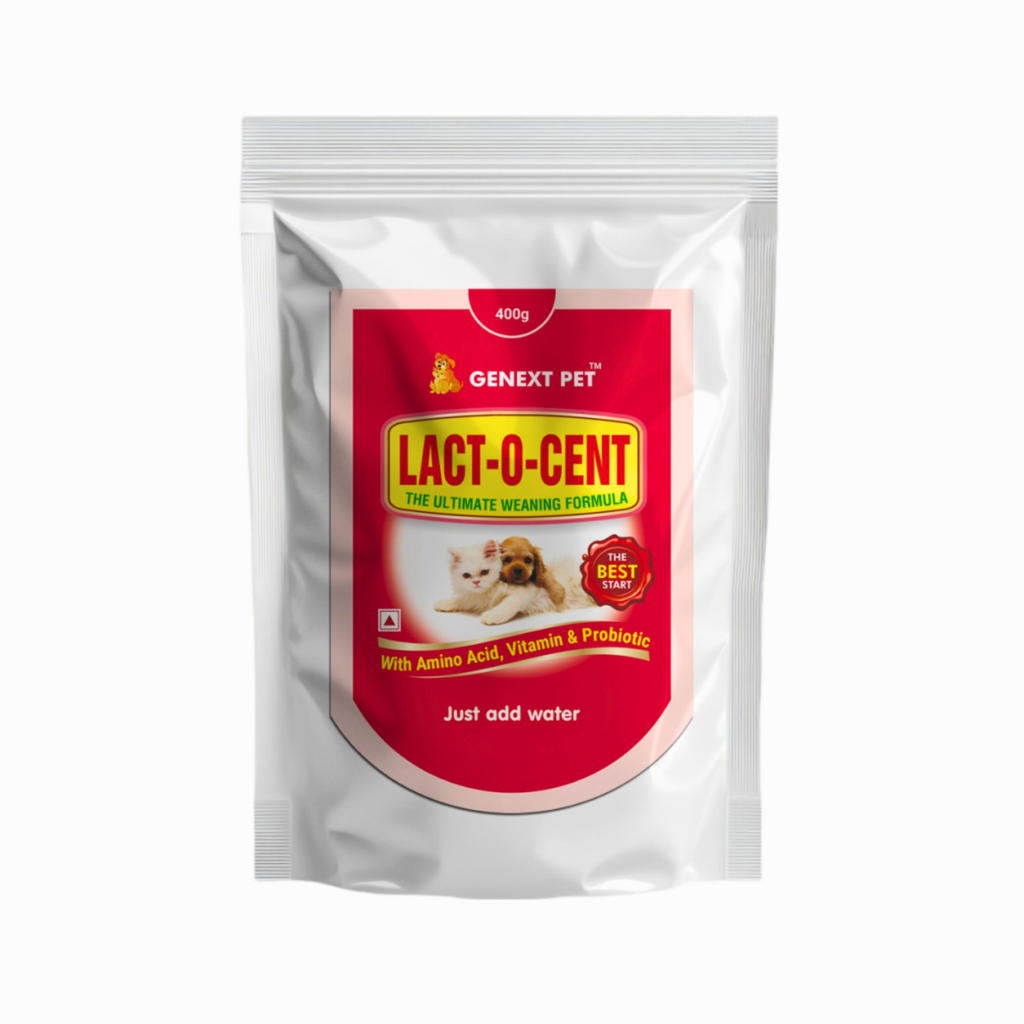
Because kittens are small, one pack goes a long way for a single kitten, and a litter uses it much faster.
| Kitten age | Powder per day (one kitten) | One 400 g pack lasts about |
|---|---|---|
| Week 1 | 6-12 g | 33-66 days |
| Week 2 | 12-18 g | 22-33 days |
| Week 3 | 18-24 g | 17-22 days |
| Week 4 | 24-30 g | 13-17 days |
From birth to weaning, one kitten uses roughly 500 g of powder, a little over one pack. A litter of four needs about five packs to reach weaning, which is why fosters and rescuers keep two or three packs in hand.
When and How to Wean a Kitten
Formula is the only food until about 3 to 4 weeks. Then move to solid food slowly:
| Age | What to offer | Bottle feeds |
|---|---|---|
| Week 3-4 | Formula in a shallow saucer to learn lapping | Continue as usual |
| Week 4-5 | Formula mixed with wet kitten food into a thin gruel | Slowly fewer |
| Week 5-6 | Thicker gruel; a shallow bowl of fresh water | Cut down |
| Week 6-8 | Wet or soaked kitten food on its own | Stop |
Go at the kitten’s pace; a slow eater can stay on some formula longer. Lact-O-Cent can be mixed into food as a nutritional top-up through weaning. Raising puppies too? Our puppy milk replacer feeding guide covers the differences.
-
Sale!
Puppy & Kitten Starter Kit – Lact-O-Cent + Neobiotic DFM + CAL
Original price was: ₹1,440.₹1,188Current price is: ₹1,188.
Final Word
Warmth first, then formula. Weigh daily, feed by weight with a kitten milk replacer that contains taurine, hold the kitten belly-down, help it pee after every feed, and never use cow’s milk. Start weaning at 3 to 4 weeks. When a kitten is very young, cold or not gaining, call your vet early rather than late.
Frequently Asked Questions
How much kitten milk replacer should I feed a newborn kitten?
About 18 ml of made-up formula per 100 g of body weight per day. A 100 g newborn needs roughly 18 ml a day, split into 7-8 feeds of 2-3 ml every 3 hours. Increase as the kitten grows, and check with your vet for weak or very small kittens.
How often should a newborn kitten be fed?
Every 2-4 hours in the first week, including at night, then every 4-6 hours until weaning at 3-4 weeks.
Can I give a kitten cow’s milk?
No. Cow’s milk has about half the protein of a mother cat’s milk, too little taurine and too much lactose. It often causes loose stool, which is dangerous for a tiny kitten. Use a kitten milk replacer.
How do I mix kitten formula?
Mix Lact-O-Cent at 1 g powder to 3 ml lukewarm water (about 38°C) and shake until smooth. Make only one day’s supply, keep it in the fridge and throw away anything left out for over an hour.
Can kittens drink puppy milk replacer?
Only if it is made for kittens too and contains taurine. Lact-O-Cent is a puppy and kitten formula with taurine. For kittens, feed by body weight rather than the per-feed amounts written for puppies.
How much weight should a kitten gain each day?
At least 7 g a day and about 100 g a week. Newborns weigh 80-120 g and usually double their weight in the first one to two weeks. Weigh at the same time every day.
Why is my kitten not drinking from the bottle?
The most common reason is that the kitten is cold; warm it first. Also check the formula is warm, the teat drips one drop at a time, and the kitten is belly-down. If it still will not suck, see your vet the same day.
My kitten has diarrhoea on formula. What should I do?
Check the mixing ratio, make sure the formula is warm, and reduce the volume a little. Diarrhoea dehydrates kittens fast, so if it lasts more than a few feeds or the kitten seems weak, see your vet.
How long does a 400 g pack of Lact-O-Cent last for a kitten?
From birth to weaning one kitten uses about 500 g of powder, so a little over one pack. A litter of four needs about five packs.
When can kittens stop drinking milk replacer?
Weaning starts at 3-4 weeks with formula in a saucer, then formula mixed into wet kitten food. Most kittens eat solid food on their own by 6-8 weeks.
Sources
- Feeding Orphaned Kittens – VCA Animal Hospitals
- Lact-O-Cent product label and directions, GenextPet