
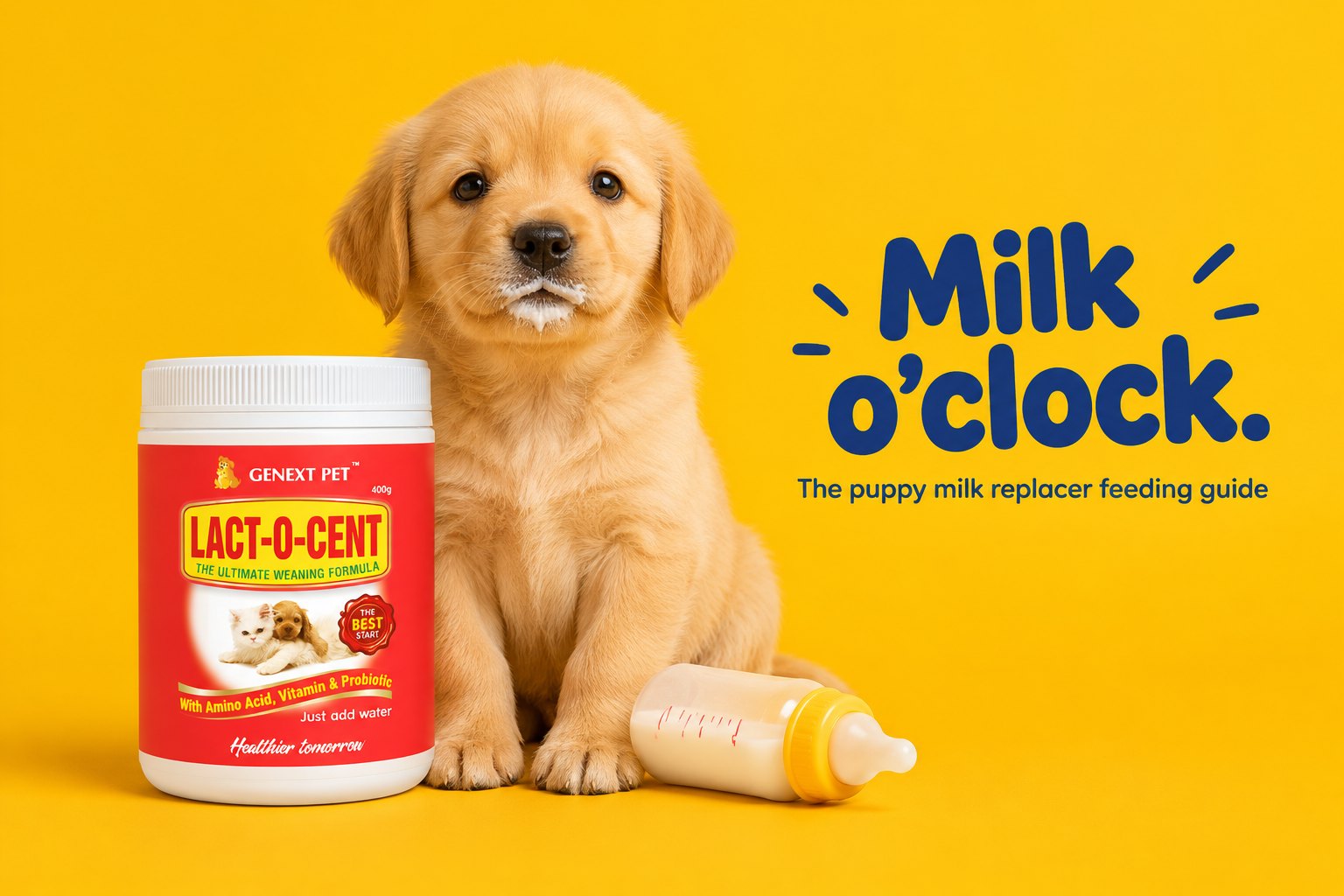
A puppy milk replacer is a powdered formula made to stand in for the mother’s milk when she cannot feed the litter, has too little milk, or the litter is too big for her. Mixed with lukewarm water and fed by bottle or syringe, it carries a puppy through the first weeks until it can eat solid food.
Getting it right matters more than most people expect. Newborn puppies cannot keep themselves warm, cannot regulate how much they drink, and cannot even pee on their own for the first three weeks. The amount, the temperature, the position and the timing all make a difference to whether a puppy gains weight or struggles.
This guide covers how much to feed by age, how often, how to mix and give it safely, how long a pack lasts, and when to start weaning. The amounts are the directions printed on Lact-O-Cent, our puppy and kitten weaning formula. For a newborn, a weak puppy, or a puppy that is not gaining weight, always check with your vet.
Quick Answer: How Much Puppy Milk Replacer to Feed
| Puppy age | Powder per feed | Lukewarm water per feed | Feeds per day |
|---|---|---|---|
| Up to 4 weeks | 10-20 g | 30-60 ml | 4-5 |
| 4 to 8 weeks | 20-40 g | 60-120 ml | 3-4 |
| Above 8 weeks | 40-80 g | 120-240 ml | 2-3 |
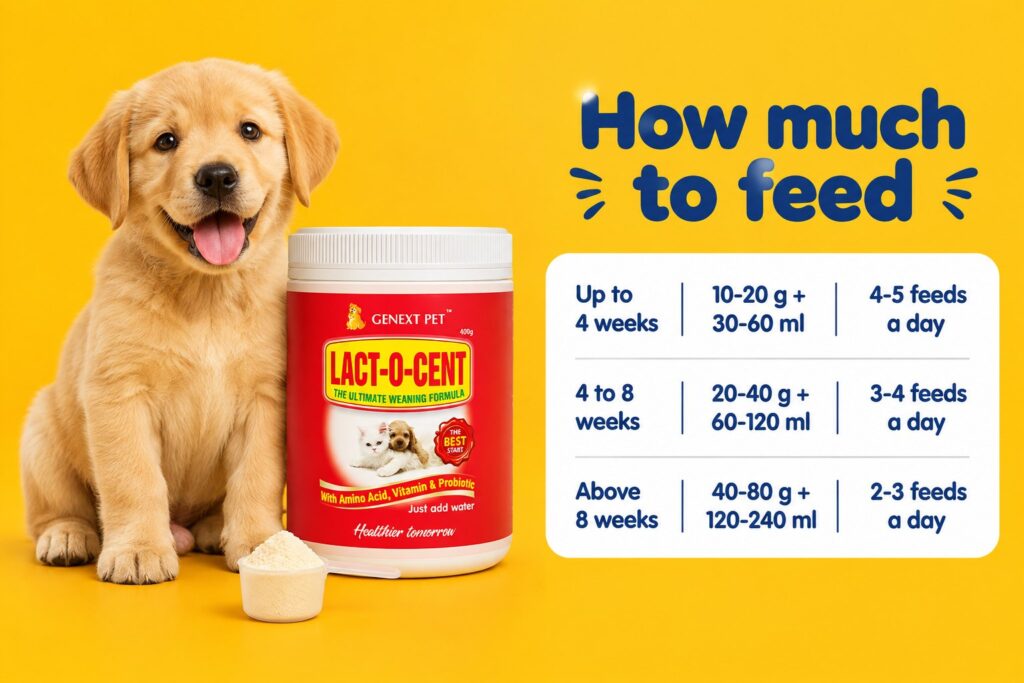
Use the lower end of each range for small breeds and the higher end for large breeds, then adjust to your puppy’s daily weight gain. Kittens follow the same chart by age and weight.
In the first week of life, vets usually advise smaller feeds more often: every 2 to 4 hours on a fixed schedule, then every 4 to 6 hours until weaning (VCA Animal Hospitals). Split the day’s amount across those feeds rather than adding more powder.
When Does a Puppy Need a Milk Replacer?
Mother’s milk is always the first choice. A milk replacer is for the times it is not enough or not available:
- Orphaned puppies whose mother has died or abandoned the litter.
- Large litters where the smaller puppies get pushed off the teats and fall behind.
- Low milk supply in the mother, common after a difficult birth, a C-section or illness.
- A mother on medication that the vet says should not pass into the milk.
- Weak or small puppies that need top-up feeds between nursing sessions.
- Weaning support from 3-4 weeks, mixed into the first soft food.
If a puppy is crying constantly, feels cold, or is not gaining weight while nursing, it may not be getting enough milk. Weigh the litter and talk to your vet before adding top-up feeds.
Why Not Just Give Cow’s Milk?
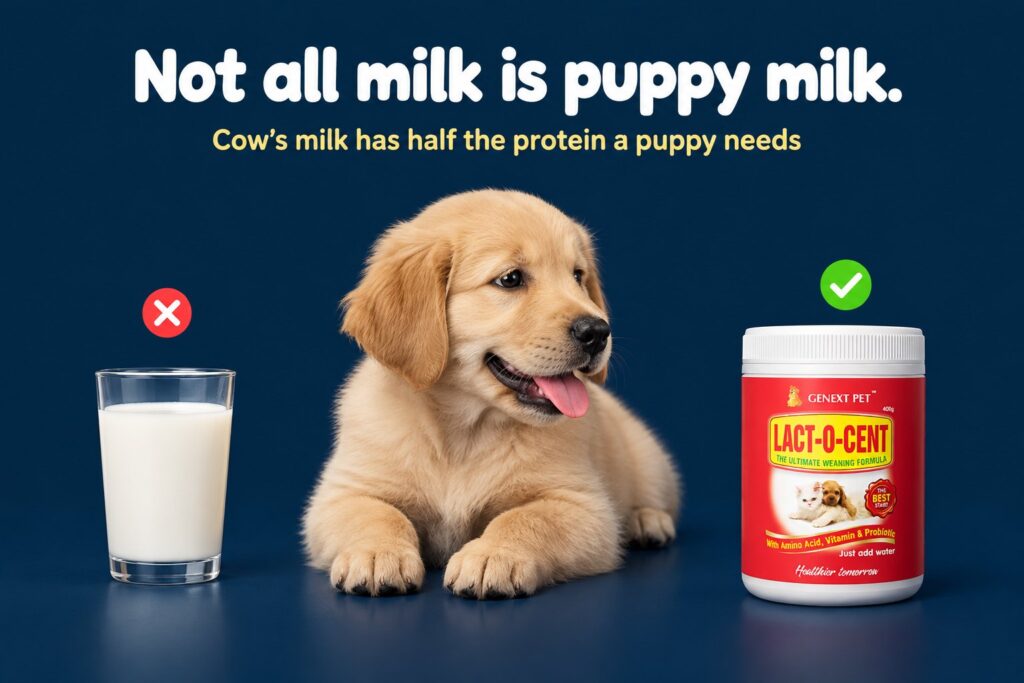
Cow’s milk is the most common mistake. A mother dog’s milk has more than twice the protein of cow’s milk, more fat and calories, and less lactose (VCA). Cow’s milk fills a puppy’s stomach without giving it what a growing body needs, and the extra lactose often upsets the tummy.
| Option | Protein for growth | Lactose | Verdict |
|---|---|---|---|
| Mother’s milk | High | Low | Best, whenever available |
| Puppy milk replacer | Made to match a puppy’s needs | Low | Best substitute |
| Cow’s milk | About half of what a puppy needs | High | Avoid |
| Goat’s milk | Lower than mother’s milk | Moderate | Only in an emergency, short term |
| Homemade egg and milk mix | Not balanced | Varies | Avoid: unbalanced and spoils fast |
Homemade recipes are best kept for a true emergency of a few hours while you get a proper formula.
What to Look For in a Puppy Milk Replacer
- Protein high enough for growth. Lact-O-Cent has 21% protein.
- Low lactose, so it is gentle on the stomach. Lact-O-Cent has 5% lactose.
- Calcium and phosphorus for bones and teeth, plus vitamins A, D, E, C and B-complex.
- Amino acids puppies and kittens need, including taurine, lysine, methionine and arginine.
- Fat and essential fatty acids for energy and brain and eye development.
- Mixes smoothly in lukewarm water, without lumps that block a bottle teat.
- Works for both puppies and kittens, useful if you foster or breed both.
Lact-O-Cent also includes a probiotic (Saccharomyces boulardii) and nucleotides, which support the gut and early growth.
-
Sale!
 This product has multiple variants. The options may be chosen on the product page
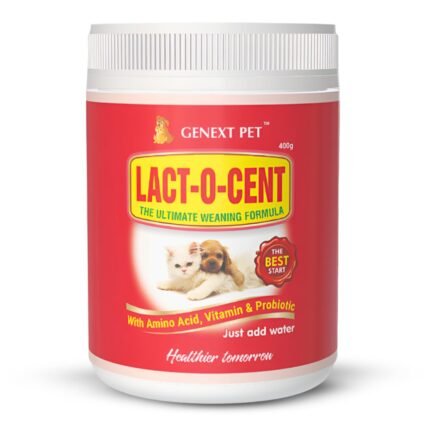
Lact-O-Cent® – Advanced Weaning & Growth Formula for Puppies & Kittens | 400g
Price range: ₹522 through ₹1,557
How to Prepare the Formula
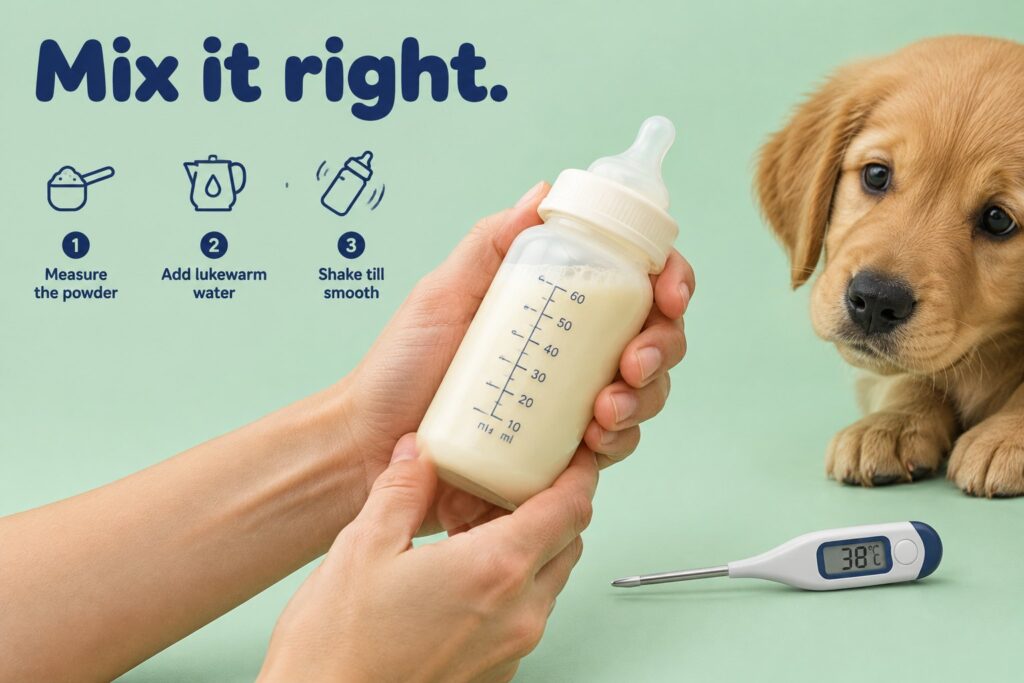
- Clean everything. Wash your hands. Wash the bottle, teat and scoop, and boil them between uses.
- Measure the powder for one feed from the chart above.
- Add lukewarm water, not hot. Aim for about body temperature, around 38°C. Test a few drops on your wrist: it should feel warm, not hot.
- Mix or shake until completely smooth. Lumps can block the teat or upset the stomach.
- Store safely. Make no more than one day’s supply at a time and keep it in the fridge. Throw away any formula left out for more than an hour (VCA).
Never microwave the bottle. Microwaves heat unevenly and leave hot spots that can burn a puppy’s mouth. Stand the bottle in a bowl of warm water instead.
How to Bottle-Feed a Puppy Safely
- Belly down, never on its back. Hold the puppy flat, head level, the way it would lie to nurse from its mother. Feeding a puppy on its back can let milk into the lungs.
- Check the flow. Turned upside down, the teat should drip one drop at a time. A fast stream can choke the puppy; too slow and it tires before it has eaten enough.
- Let the puppy set the pace. Never squeeze milk into its mouth. Let it suck and stop on its own.
- Warm the puppy first. A cold puppy will not feed well. Keep it on a warm (not hot) towel or heating pad before and after feeds.
- Help it pee and poop. Puppies under about 3 weeks cannot go on their own. After each feed, gently rub the area under the tail with warm, damp cotton until it goes. The mother normally does this.
- Clean the face after each feed so milk does not dry on the skin.
For very small or weak puppies, a syringe works when a bottle is too hard. Go slowly, a drop at a time, and give the puppy time to swallow.
How to Tell Your Puppy Is Getting Enough
Weigh each puppy on a kitchen scale every day for the first 4 weeks, then once a week. A healthy puppy gains weight every day and roughly doubles its birth weight by day 10 (VCA). A full, contented puppy sleeps quietly after feeds.
Call your vet the same day if a puppy:
- Loses weight or stops gaining for a day
- Cries constantly, feels cold, or will not suck
- Has milk coming out of its nose, coughs or breathes noisily after feeds
- Has a bloated belly or watery stool
It is better to slightly underfeed than overfeed a newborn. Overfeeding, cold formula and feeding too fast are the usual causes of bloating and loose stool.
How Long Does a 400 g Pack Last?
This depends on the puppy’s age and size. Using the label amounts for one puppy:
| Puppy age | Powder per day (one puppy) | One 400 g pack lasts about |
|---|---|---|
| Up to 4 weeks | 40-100 g | 4-10 days |
| 4 to 8 weeks | 60-160 g | 2.5-6.5 days |
| Above 8 weeks (top-up) | 80-240 g | 2-5 days |
A litter of four or five puppies on formula can use a pack in a day or two. That is why breeders and fosters usually keep two or three packs in hand, so they never run out in the middle of the night.
When and How to Wean
Formula is the only food until about 3 to 4 weeks of age. Then start weaning slowly:
| Age | What to offer | Bottle feeds |
|---|---|---|
| Week 3-4 | A shallow dish of formula so the puppy learns to lap | Continue as usual |
| Week 4-5 | Formula mixed with a little soaked puppy food into a soft porridge | Slowly fewer |
| Week 5-6 | Thicker porridge, less liquid | Cut down further |
| Week 6-8 | Soft puppy food; formula as a top-up mixed into food | Stop |
Go at the puppy’s pace. A puppy that is not eating well on solids can stay on formula a little longer. Lact-O-Cent can be continued beyond 8 weeks as a nutritional top-up mixed with food. Our puppy growth stages guide covers what to expect month by month.
-
Sale!
Puppy & Kitten Starter Kit – Lact-O-Cent + Neobiotic DFM + CAL
Original price was: ₹1,440.₹1,188Current price is: ₹1,188.
Final Word
A good milk replacer, given warm, belly-down and on a steady schedule, can raise a healthy litter when the mother cannot. Weigh daily, keep everything clean, never use cow’s milk, and start weaning at 3 to 4 weeks. When in doubt, especially with a newborn or a weak puppy, call your vet early rather than late.
Frequently Asked Questions
How much puppy milk replacer should I give a newborn puppy?
For puppies up to 4 weeks, the Lact-O-Cent label gives 10-20 g powder in 30-60 ml lukewarm water per feed, 4-5 times a day. In the first week, vets usually advise splitting this into smaller feeds every 2-4 hours. Adjust to daily weight gain and check with your vet for very small or weak puppies.
How often should I feed a puppy milk replacer?
Every 2-4 hours in the first week, then every 4-6 hours until weaning. From 4-8 weeks, 3-4 feeds a day; above 8 weeks, 2-3 feeds a day as a top-up alongside solid food.
Can I give my puppy cow’s milk instead of milk replacer?
No. Cow’s milk has about half the protein of a mother dog’s milk and more lactose, so it does not support growth and often upsets the stomach. Use a milk replacer made for puppies.
What temperature should puppy milk replacer be?
About body temperature, around 38°C. It should feel warm, not hot, on your wrist. Never microwave it; warm the bottle in a bowl of warm water.
How long can a puppy stay on milk replacer?
It is the main food until weaning starts at 3-4 weeks, and is used alongside solid food through weaning, usually until 6-8 weeks. It can be continued after 8 weeks as a top-up mixed into food.
Can I use puppy milk replacer for kittens?
Lact-O-Cent is made for both puppies and kittens, and kittens follow the same chart by age and weight. Some puppy-only formulas lack the taurine kittens need, so always check the label.
How long does a 400 g pack of Lact-O-Cent last?
For one puppy under 4 weeks it lasts about 4-10 days, depending on size. Older puppies and whole litters use it faster; a litter of four or five can use a pack in a day or two.
My puppy has loose stool on formula. What should I do?
Check that you are mixing the right amount of powder, that the formula is warm, and that you are not overfeeding. Reduce the volume slightly. If it continues past a day, or the puppy seems weak, see your vet.
How do I know my puppy is getting enough milk?
Weigh it daily. A healthy puppy gains weight every day and roughly doubles its birth weight by day 10. A well-fed puppy sleeps quietly after feeds; constant crying is a warning sign.
When should I start weaning puppies off milk replacer?
Start at 3-4 weeks by offering formula in a shallow dish, then mix it with soaked puppy food. Most puppies eat soft food on their own by 6-8 weeks.
Sources
- Feeding Orphaned Puppies – VCA Animal Hospitals
- Lact-O-Cent product label and directions, GenextPet