
Quick answer
A probiotic can help a cat through short tummy upsets: stress diarrhoea after a move or boarding, a course of antibiotics, or a food change. It is not a treatment for a cat that is vomiting, has stopped eating or has blood in its stool; that cat needs a vet. Choose a probiotic made for cats or for dogs and cats, with the strains and the CFU count printed on the label, and give it with food once or twice a day.
Most cat parents in India first think about probiotics when the litter box shows soft or runny stool. Sometimes that is the right moment. Sometimes it is a sign the cat needs a vet that same day. This guide explains what a probiotic actually does for a cat, when it can help, what the research shows, how to choose one and how to get a fussy cat to take it.
What a Probiotic Does in a Cat’s Gut
A cat’s intestine holds a large community of bacteria and yeasts. When that balance is upset, by stress, a sudden food change or antibiotics, the stool often turns soft. A probiotic adds friendly microbes for a while. They help crowd out unfriendly ones and support normal digestion while the cat’s own gut community settles again.
Probiotics work best alongside a prebiotic, which is fibre that feeds the good bacteria. Our guide on probiotics vs prebiotics explains the difference in more detail.
When a Probiotic Can Help Your Cat
| Situation | Can a probiotic help? | What to know |
|---|---|---|
| Soft stool after a move, boarding, travel or a new pet | Often, yes | Start a few days before a planned stay away and continue for a week after. |
| On a course of antibiotics | Often, yes | Give it 2 to 3 hours apart from the antibiotic and continue for 1 to 2 weeks after the course ends. |
| Changing to a new food | Can help | Change food slowly over 7 to 10 days as well; a probiotic does not replace a gradual switch. |
| Occasional soft stool in a healthy, eating cat | Can help | If it lasts more than 2 to 3 days, see your vet. |
| Kittens with diarrhoea | Only with your vet | Kittens dehydrate quickly. See a vet first, then ask whether a probiotic suits. |
| Long-term diarrhoea, weight loss, a diagnosed bowel condition | Possibly, as part of a vet plan | A probiotic can support treatment but is not the treatment. |
When to See a Vet Instead
Do not wait and try a probiotic first if your cat has any of these:
- Blood in the stool, or black, tarry stool.
- Vomiting more than once, or vomiting and diarrhoea together.
- Has stopped eating, or is hiding and unusually quiet.
- Diarrhoea in a kitten, or diarrhoea lasting more than 2 to 3 days in an adult cat.
- Straining in the litter box with little or nothing coming out. This can look like constipation but may be a blocked bladder, which is an emergency, especially in male cats.
- Weight loss, or diarrhoea that keeps coming back.
What the Research Shows
The evidence for probiotics in cats is promising but still small, so it helps to know what has actually been tested:
- Shelter cats: in a double-blind, placebo-controlled study of 217 shelter cats, fewer cats given the probiotic Enterococcus faecium SF68 had diarrhoea lasting two days or more (about 7.7% vs 20.7% on placebo). The probiotic did not change how many cats had short one-day episodes (Bybee and others, 2011).
- During antibiotics: in a crossover trial in healthy research cats on clindamycin, cats given a synbiotic (a probiotic plus prebiotic) ate better, and all of them finished the antibiotic course in the first period compared with half of the cats on placebo. Vomiting fell, though not by a statistically clear margin, and stool scores were not different (Stokes and others, 2017).
- Different strains, different results: each study tests a specific strain. Results for one strain do not automatically apply to another, which is why the strain names on the label matter.
In short: probiotics are a sensible, low-risk support for short-term upsets and antibiotic courses. They are not a cure-all, and a sick cat still needs a diagnosis.
How to Choose a Probiotic for Your Cat
- Made for pets. Pick a product labelled for cats, or for dogs and cats, with a cat dose on the label. Human probiotic capsules often carry flavours or added ingredients that are not meant for cats, and doses are not worked out for a 4 kg animal.
- Strains named on the label. A good product lists each strain, not just “probiotic blend”.
- A CFU count you can see. CFU (colony-forming units) tells you how many live microbes a dose gives. No count means no way to know the dose.
- Survives Indian heat. Spore-forming strains such as Bacillus subtilis are hardy and do not need a fridge, which matters in Indian summers.
- A prebiotic included. Ingredients such as MOS (mannan-oligosaccharides) or beta-glucan feed the good bacteria.
- Easy to give. A fine, mild-tasting powder mixes into wet food better than a capsule or tablet for most cats.
What about curd or buttermilk?
Curd is a common home remedy, but it is not a reliable probiotic for cats. The live culture count is unknown, and cow’s milk carries more lactose than a cat’s mother’s milk; lactose is a common cause of loose stools in cats (VCA Hospitals). A small lick of plain curd is unlikely to harm most cats, but it should not replace a proper probiotic or a vet visit.
How to Give a Probiotic to a Fussy Cat
- Mix the powder into a small amount of wet food first, a teaspoon or two, so the full dose is eaten. Then give the rest of the meal.
- Use food that is warm, not hot. Probiotics are living microbes and heat can damage them.
- Split the daily amount into two meals if your cat eats twice a day.
- If your cat refuses it, start with less and build up over 3 to 4 days.
- During antibiotics, keep a 2 to 3 hour gap between the antibiotic and the probiotic.
Neobiotic DFM for Cats
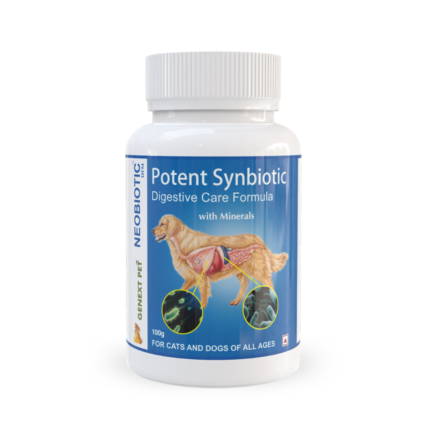
GenextPet Neobiotic DFM is a probiotic and prebiotic powder for dogs and cats. Each gram gives 12.5 million CFU from three probiotics, Bacillus subtilis, Bacillus licheniformis and Saccharomyces boulardii, with MOS and beta-glucan, live yeast culture and trace minerals. The two Bacillus strains are spores, so the powder keeps well without a fridge.
| Pet | Daily dose | Spoons (4 g spoon) | A 100 g pack lasts |
|---|---|---|---|
| Cat (any size) | 1 to 2 g, twice a day | ¼ to ½ spoon, twice a day | 25 to 50 days |
Give it with food, never on an empty stomach. The specific strains in Neobiotic have not been tested in the cat studies above, which used other strains, so treat it as gut support for short-term upsets, not as a treatment for illness. Not sure which supplement your cat needs? Try the 30-second Supplement Finder.
Final Word
A probiotic is a useful, gentle tool for a cat’s everyday tummy troubles, especially around stress, food changes and antibiotics. Pick one with named strains and a CFU count, give it with food, and know the warning signs that mean your cat needs a vet rather than a supplement.
Frequently Asked Questions
Can I give my cat a human probiotic?
It is better not to. Human probiotics are dosed for people and often contain flavours or added ingredients not meant for cats. Use a product made for cats, or for dogs and cats, with a cat dose on the label.
How long does a probiotic take to work in a cat?
For a short stress or food-change upset, stool usually improves within a few days. If there is no improvement in 2 to 3 days, or your cat seems unwell, see a vet.
Can kittens take probiotics?
Yes, many pet probiotics can be used for kittens, but a kitten with diarrhoea should see a vet first because kittens dehydrate quickly. Ask your vet about the right amount.
Can I give curd to my cat for loose motion?
Curd is not a reliable probiotic for cats. Its live culture count is unknown and cow’s milk lactose can itself cause loose stools in cats. Use a pet probiotic, and see a vet if loose motion continues.
Should I give a probiotic with antibiotics?
It can help. Give the probiotic 2 to 3 hours apart from the antibiotic and continue for 1 to 2 weeks after the course ends. Always finish the antibiotic course your vet prescribed.
Is it safe to give a cat probiotics every day?
Pet probiotics are generally well tolerated for daily use. Many owners use them for a few weeks around a stressful period or antibiotics. For long-term daily use, check with your vet, especially if your cat has an ongoing health condition.
Sources
- Bybee SN, Scorza AV, Lappin MR. Effect of the probiotic Enterococcus faecium SF68 on presence of diarrhea in cats and dogs housed in an animal shelter. J Vet Intern Med, 2011
- Stokes JE, Price JM, Whittemore JC. Randomized, controlled, crossover trial of prevention of clindamycin-induced gastrointestinal signs using a synbiotic in healthy research cats. J Vet Intern Med, 2017
- VCA Hospitals: Feeding orphaned kittens (cow’s milk and lactose)
About Author
Dr. Kevin Modi
Dr. Kevin Modi is a trusted voice in the Indian pet care space, with years of hands-on experience in pet wellness, gut health, and natural supplements. At GenextPet, he guides product formulation and ensures content accuracy, drawing from real-world insights and the latest research. His goal? To simplify pet health for every dog and cat parent.